
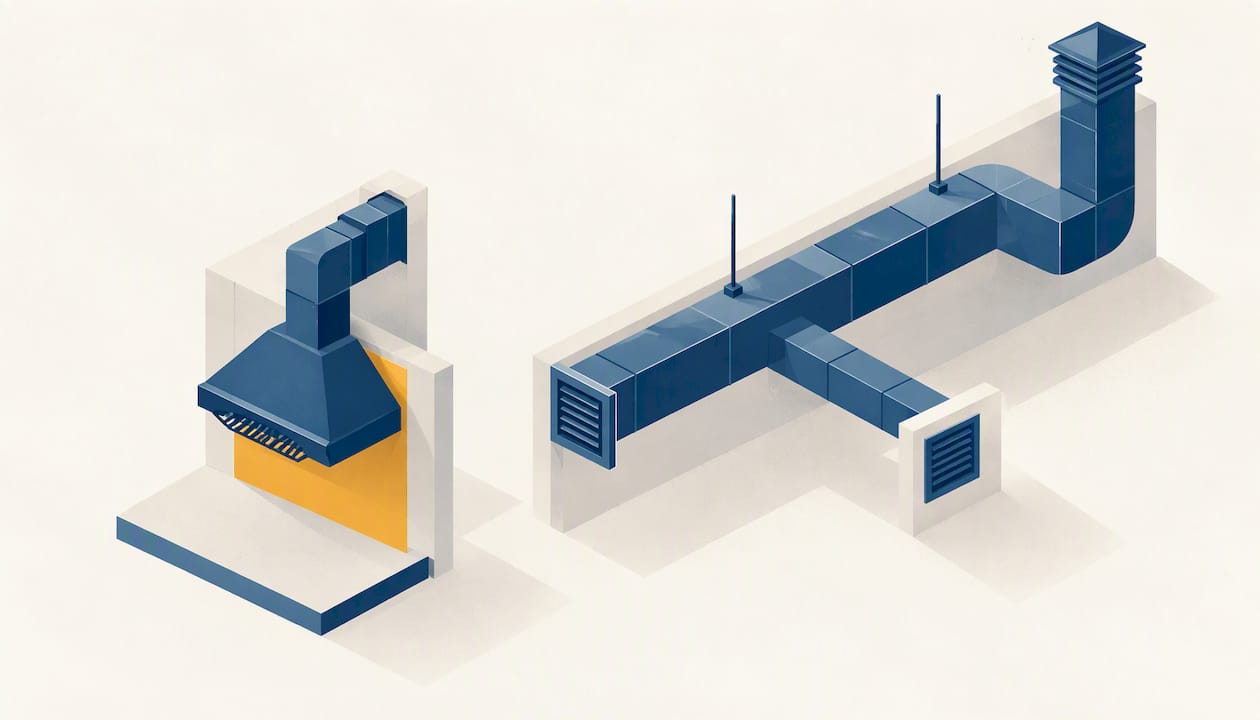
Hood cleaning and duct cleaning are not two names for the same job. Kitchen exhaust cleaning removes grease from the hood, filters, ductwork and exhaust fan above your cooking line, and it is a fire-safety requirement. HVAC duct cleaning removes dust from heating and air-conditioning ducts, and it is a discretionary maintenance choice. If you run a restaurant, café, hotel or catering kitchen in Winnipeg, the first is a scheduled obligation. The second is optional.
This article sets out the differences in purpose, method, regulation and frequency. It also shows how to avoid paying twice for the wrong service.
TL;DR
- Kitchen exhaust (hood, duct and fan) cleaning is a fire-prevention service tied to NFPA 96 and the Manitoba Fire Code. Routine HVAC duct cleaning is not required by code in Canada.
- Exhaust systems are cleaned of grease to bare metal. HVAC ducts are vacuumed and brushed to remove dust.
- Frequency depends on cooking volume: monthly, quarterly, semi-annually or annually.
- Before you hire, ask for proof of certification, Winnipeg licensing and before-and-after documentation.
- A company offering “duct cleaning” is not necessarily qualified to clean a grease exhaust system.
Table of Contents
- Two services that share a word
- Hood vs duct cleaning at a glance
- Why kitchen exhaust cleaning is mandatory
- Why HVAC duct cleaning is a different question
- What the two services involve
- How often each service is needed
- Duct grease leaks: a warning sign, not a cleaning type
- Our perspective: where the confusion costs operators money
- How to choose the right contractor
- Book the right service the first time
- FAQ
- Sources
Two services that share a word
The confusion comes from the word “duct.” A restaurant has at least two duct systems:
- The kitchen exhaust system. It captures grease-laden vapour at the hood and carries it through a grease duct to an exhaust fan, usually on the roof. The Manitoba guideline for food handling establishments describes the purpose of commercial kitchen ventilation as capturing and removing contaminants such as grease, smoke, vapours and odours.
- The HVAC system. It heats, cools and circulates air through supply and return ducts. These ducts carry dust, not cooking grease.
The two systems differ in what builds up inside them, how dangerous it is, and which rules apply. A cleaner who works mostly on furnaces and air ducts usually does not hold the training, equipment or documentation that a grease exhaust job calls for.
Hood vs duct cleaning at a glance
| Factor | Kitchen exhaust (hood, duct, fan) cleaning | HVAC duct cleaning |
|---|---|---|
| What is removed | Grease, oil residue, carbon deposits | Dust, debris, sometimes mould |
| Main purpose | Fire prevention and inspection compliance | Air quality or system upkeep (benefit is debated) |
| Required by code | Yes, under NFPA 96 as adopted in Manitoba | No routine requirement in Canada |
| Method | Degreasing agents and high-pressure washing to bare metal | Vacuuming and mechanical brushing |
| Frequency | Set by cooking volume, monthly to annually | At the owner’s discretion |
| Proof expected | Certified technicians, before-and-after photos, inspection report | Usually none |
| Risk of skipping | Grease fire, failed inspection, forced re-cleaning | Mostly cosmetic or comfort-related |
Why kitchen exhaust cleaning is mandatory
Grease vapour condenses on cool metal surfaces inside the hood and duct. Layer by layer, it forms a fuel load that a flare-up at the fryer or charbroiler can ignite. NFPA 96 provides preventive and operative fire safety requirements meant to reduce the fire hazard of commercial cooking operations. Manitoba’s food handling regulation sits alongside the fire code, and the Food and Food Handling Establishments Regulation is the document health inspectors work from.
The standard requires the whole system to be cleaned of grease and oil residue to bare metal. North Bay Fire and Emergency Services states this plainly in its guidance for operators, and the same expectation applies in Winnipeg. A surface that has been wiped or lightly scraped, with a film of grease left behind, does not meet it.
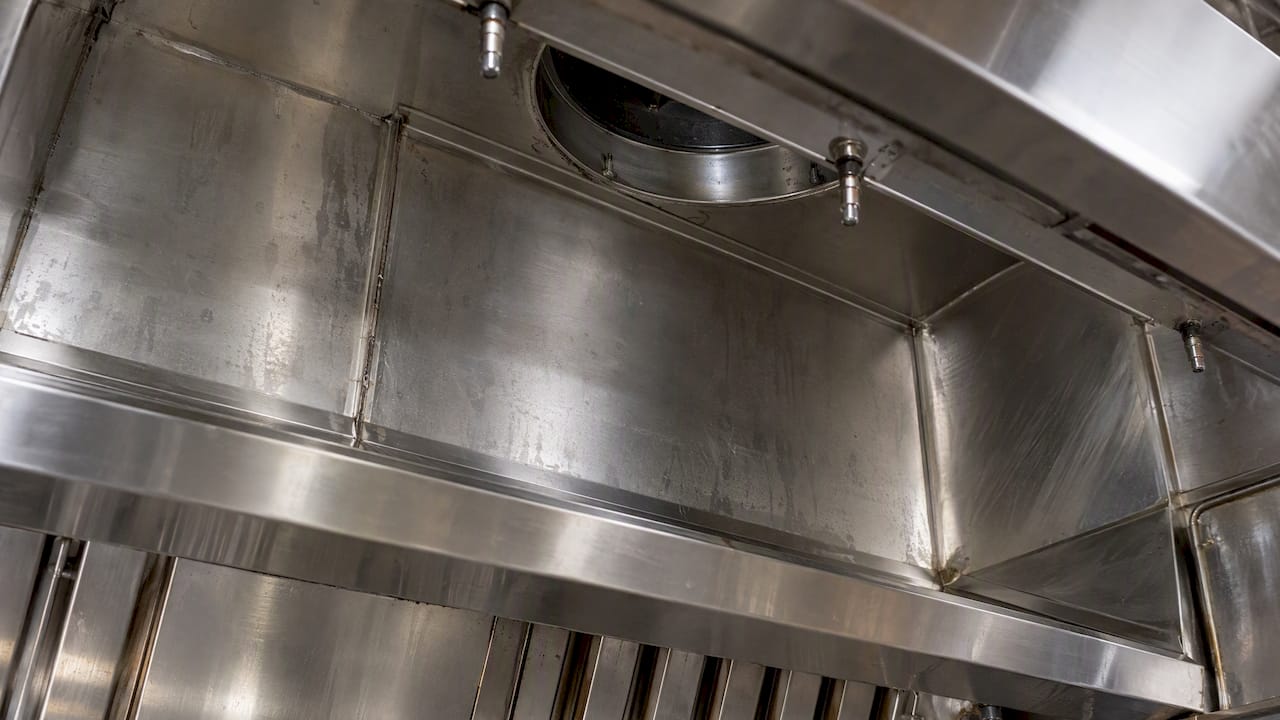
The City of Winnipeg’s information bulletin on commercial cooking equipment is also useful reading for operators. It covers installation and maintenance criteria for ecology units and similar equipment used with commercial cooking, and it shows the level of detail that local officials apply to cooking exhaust.
For a closer look at how grease accumulation creates risk, see our article on how grease buildup impacts restaurant safety.
Why HVAC duct cleaning is a different question
HVAC duct cleaning is promoted for cleaner air, better health and lower energy bills. The evidence is weaker than the marketing. A review of the scientific evidence on ventilation duct cleaning from the National Research Council of Canada looked at those claims and found little scientific support for improved health or reduced energy costs. The Government of Canada’s occupant handbook on indoor air quality refers to Canada Mortgage and Housing Corporation studies showing that duct cleaning will not usually change the quality of the air in a building.
That does not mean HVAC duct cleaning is never worthwhile. Visible mould, a renovation that filled ducts with drywall dust, or pest contamination are reasonable grounds to clean. It means that you should not treat it as a compliance item, and you should not accept it as a substitute for exhaust cleaning. For general ventilation, regular filter changes do more than duct cleaning for most buildings.
What the two services involve
Kitchen exhaust cleaning
A professional exhaust cleaning covers the full path of the grease-laden air:
- Hood interior and exterior, including the plenum behind the filters.
- Filters, which are removed and degreased. Our page on hood filter cleaning explains that scope.
- Ductwork, from the hood collar to the roof or exit point.
- Exhaust fan, including the housing and blades, where grease collects and can leak.
- Inspection and documentation, including photographs before and after.
The work uses degreasing agents and pressure washing and must be carried out without flammable solvents. It is not a job for staff with a bucket and a ladder, and it is not something a standard HVAC duct cleaning machine can do. Our guide to what a professional kitchen exhaust cleaning includes walks through each stage, and the page on hood, duct and fan cleaning differences explains why each component is treated separately.
HVAC duct cleaning
This service typically uses negative-pressure vacuums and rotating brushes to dislodge and collect dust from supply and return ducts. Some contractors add sanitizers or biocides. Those add-ons are another reason to ask questions first: disturbing settled dust and introducing chemicals into the airflow can temporarily make conditions worse rather than better.
How often each service is needed
Kitchen exhaust: set by cooking volume
The Manitoba and NFPA 96 schedule ties frequency to what and how much you cook. The schedule below follows the provincial regulation and the North Bay fire service summary of the NFPA 96 table.
| Type of cooking operation | Cleaning frequency |
|---|---|
| Solid fuel (wood or charcoal) | Monthly |
| High volume (24-hour operation, charbroiling, wok cooking) | Quarterly |
| Moderate volume | Semi-annually |
| Low volume (churches, seasonal operations) | Annually |
Most Winnipeg restaurants fall into the quarterly or semi-annual bands. A fast-food outlet running fryers and charbroilers all day is a different case from a café that serves soup and sandwiches. Your inspector, not your cleaning company, has the final say on which band applies to you. For local detail, see our pages on exhaust cleaning frequency in Winnipeg and kitchen exhaust cleaning requirements.
If you change your menu, check your classification. Manitoba’s guideline notes that heavier grease-producing cooking, such as deep frying, can require a Type I hood with full NFPA 96 compliance. Our guide to Type I vs Type II hoods explains how to match the hood to the menu and what the authority having jurisdiction will look for.
HVAC ducts: no fixed schedule
There is no standard interval for HVAC duct cleaning in Canada. Clean them when there is a visible reason, not by the calendar.
Duct grease leaks: a warning sign, not a cleaning type
Operators often search for “duct grease leaks” after finding dark, sticky residue on a ceiling tile, a rooftop, or around a duct joint. Grease that escapes from the system has usually passed through a seam, a joint or an access panel, or has overflowed from a fan with no grease containment. The cause is almost always heavy buildup or a failed seal.
If you see this:
- Do not wipe it and carry on. The leak tells you grease has reached a place it should not be.
- Book a certified exhaust cleaner for an inspection of the duct run and fan, not an HVAC cleaner.
- Ask for photographs of the problem area and of the repaired or cleaned section.
- If a grease fire has already occurred, read our guidance on kitchen exhaust after a grease fire before restarting cooking.
Repairs to ductwork itself are a job for a qualified mechanical or sheet-metal contractor. Cleaning does not fix a failed joint.
Our perspective: where the confusion costs operators money
We see the same pattern in kitchens across Winnipeg. An owner receives a call or flyer offering “duct cleaning,” books it, and assumes the exhaust is covered. Months later, an inspector looks above the filters and finds grease. The kitchen then pays for the exhaust cleaning it needed in the first place, on top of the duct cleaning it did not.
Our view is that the scope of a quote should be written down before work starts. A proper exhaust quote names the hood, the filters, the ductwork, the fan and any appliances. It says whether the cleaning goes to bare metal. It says what documentation you will receive. If a quote only says “duct cleaning,” ask what that means.
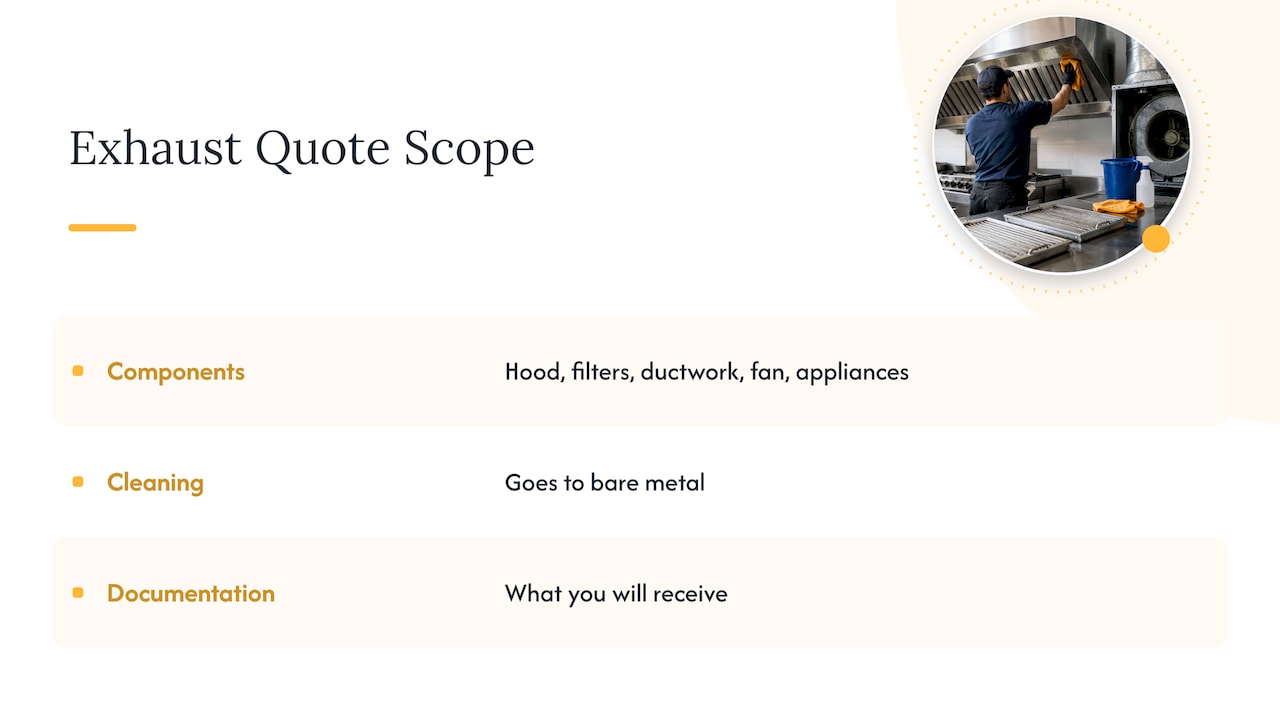
We also keep appliance cleaning separate from exhaust cleaning. Fryers, griddles, charbroilers and burners collect their own grease, and cleaning the exhaust above them does not clean them. Walls and floors are a third item. Each has its own scope, and a clear quote lists each one.
Certification matters because the duty to check it lies with you. Fire authorities in other Canadian cities say so directly: the City of Regina requires certified cleaners for commercial cooking exhaust, and a fire inspector can require the system to be cleaned again if the contractor cannot show qualifications. Regina’s rule is local to Regina, but it reflects what inspectors expect elsewhere. Our technicians are certified to national standards (MFS) and licensed by the Winnipeg Fire Department, and our work is documented to meet local bylaws.
— Jack
How to choose the right contractor
Use this checklist before signing anything:
- Does the company clean grease exhaust systems, not only air ducts? Ask how many commercial kitchens it services.
- Can it show current certification? Ask for the certificate and match the technician’s name to it.
- Is it licensed to work in Winnipeg? Winnipeg expects cleaners of commercial cooking exhaust to be authorized by the fire department.
- Will you get before-and-after photographs and a written report? Keep these on site for your inspector.
- Does it affix a service sticker with the date and next due date? This helps both you and the inspector.
- Is the scope itemized? Hood, filters, duct, fan, appliances and surfaces should each be listed.
- Does it offer reminders? Missing a quarterly window is the commonest way to fall out of compliance.
A kitchen is more than its exhaust. Cleaning the cooking line and food-prep surfaces also supports the wider food-safety routine, including allergen control. If you serve guests with dietary restrictions, this guide to celiac-safe ordering conditions shows how one Canadian food business frames the issue from the customer’s side.
Book the right service the first time
We clean commercial kitchen exhaust systems in Winnipeg: hoods, ductwork, exhaust fans and filters. We also clean fryers, griddles, charbroilers, burners, and stainless steel walls and floors. Every job comes with inspection and before-and-after documentation. Tell us your cooking type and last cleaning date, and we will outline the scope and the schedule that applies to you. Start at Hoods Kitchen Exhaust or see our appliance and wall and floor cleaning services.
FAQ
Do you need duct cleaning in a restaurant?
You need exhaust duct cleaning, because it is required by fire code. You do not need HVAC duct cleaning on a schedule, as Canadian research does not support routine cleaning for air quality or energy savings. Consider HVAC duct cleaning only when there is visible mould, construction dust or pest contamination.
Is ductwork cleaning the same as hood cleaning?
No. Hood cleaning is one part of kitchen exhaust cleaning, which also covers the duct and fan. Ductwork cleaning in the HVAC sense removes dust from air-handling ducts and does not remove baked-on grease. Ask any contractor which system it means.
How often should a Winnipeg restaurant have its exhaust cleaned?
Frequency depends on cooking volume: monthly for solid fuel, quarterly for high-volume cooking, semi-annually for moderate volume and annually for low volume. Your menu and equipment decide which applies, and your fire inspector can confirm it. Our page on cleaning frequency in Winnipeg kitchens gives more examples.
What should I do if I find grease leaking from a duct?
Stop relying on the system until a certified exhaust cleaner has inspected it. Leaks point to heavy buildup or a joint or fan problem. The cleaner can remove the grease and document the condition, and a mechanical contractor can repair any damaged seams.
Can my staff clean the hood themselves?
Staff can wipe the visible hood exterior and rinse removable filters between professional services. They cannot clean the plenum, duct and fan to bare metal, and doing so incorrectly can create a hazard. Leave the system itself to certified technicians.
Sources
- Food and Food Handling Establishments Regulation, M.R. 339/88 R
- Guideline for the Design & Construction of a Food Handling Establishment (Manitoba)
- NFPA 96 Standard Development
- Commercial Cooking Equipment, North Bay Fire and Emergency Services
- City of Winnipeg information bulletin on commercial cooking equipment
- Is ventilation duct cleaning useful? A review of the scientific evidence (NRC)
- Occupant Handbook: Indoor air quality (Canada.ca)
- City of Regina: Facility Inspections
Recommended
- Kitchen Exhaust Cleaning Winnipeg
- Hood Filter Cleaning Winnipeg
- Hood Filters: Clean or Replace?
- Kitchen Exhaust Cleaning Requirements in Winnipeg
Need your exhaust cleaned?
Tell us what needs cleaning and your preferred timing. We’ll help you plan the next step.
- We’ll get back to you within 1 business day.
- Commercial kitchens only.


